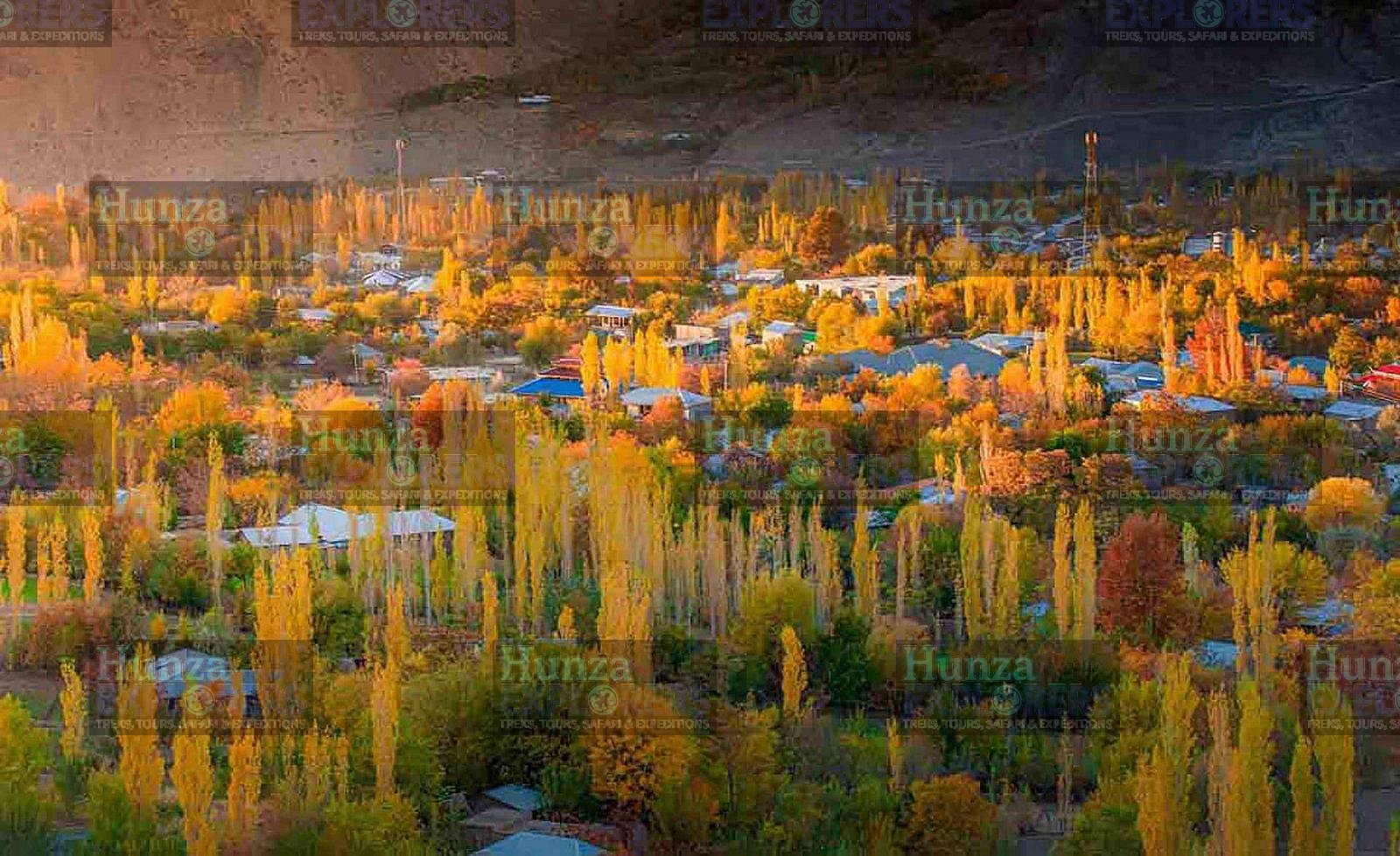
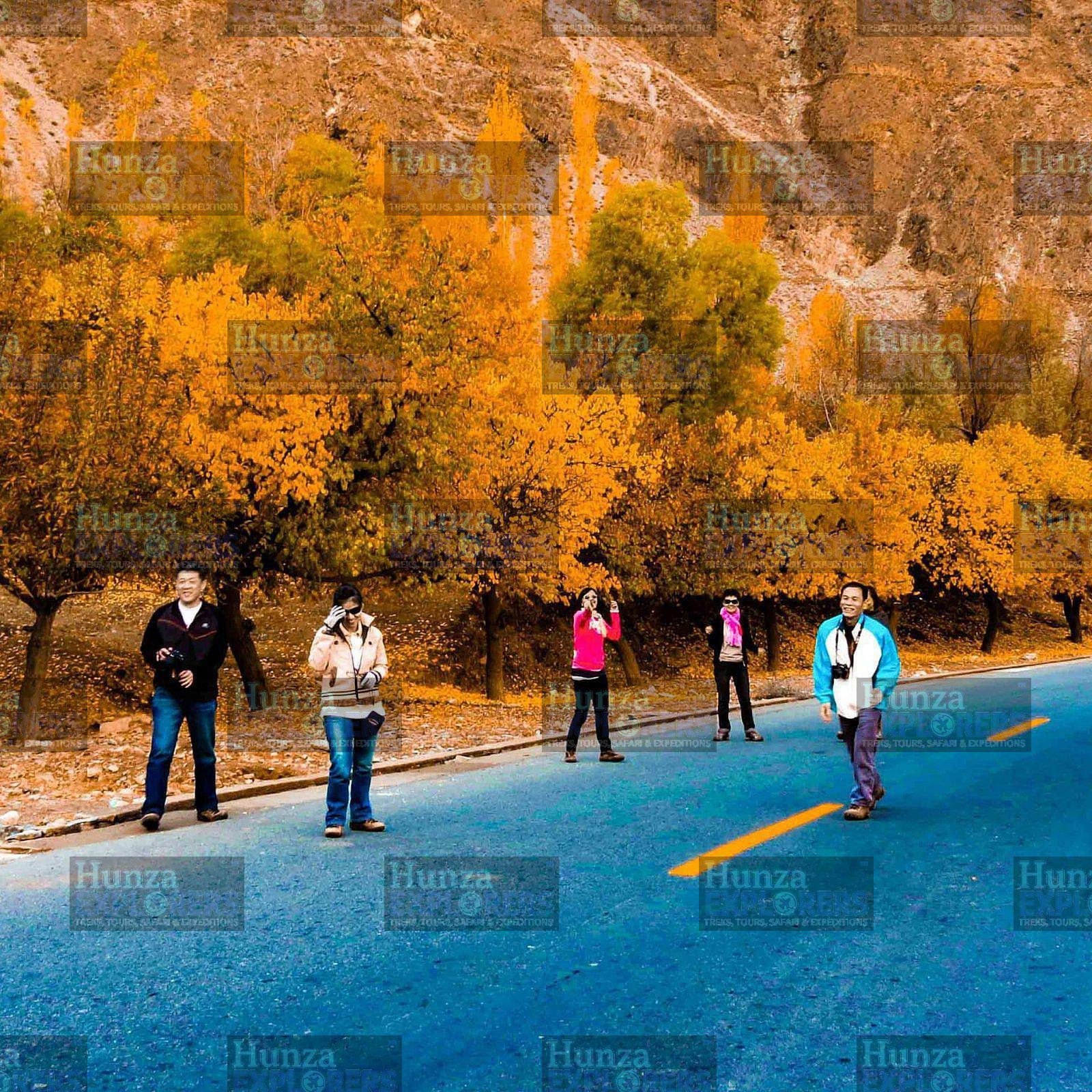
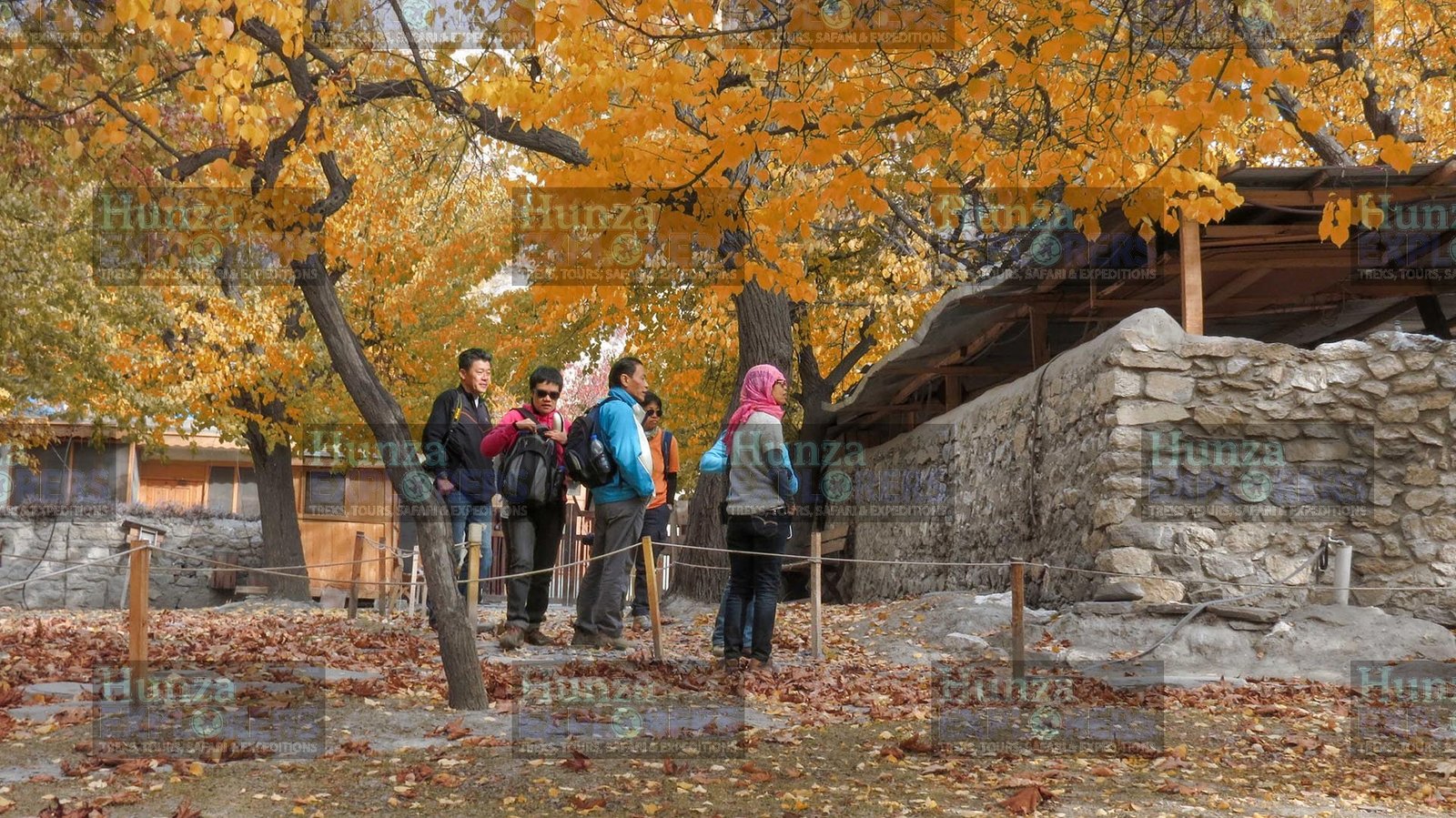
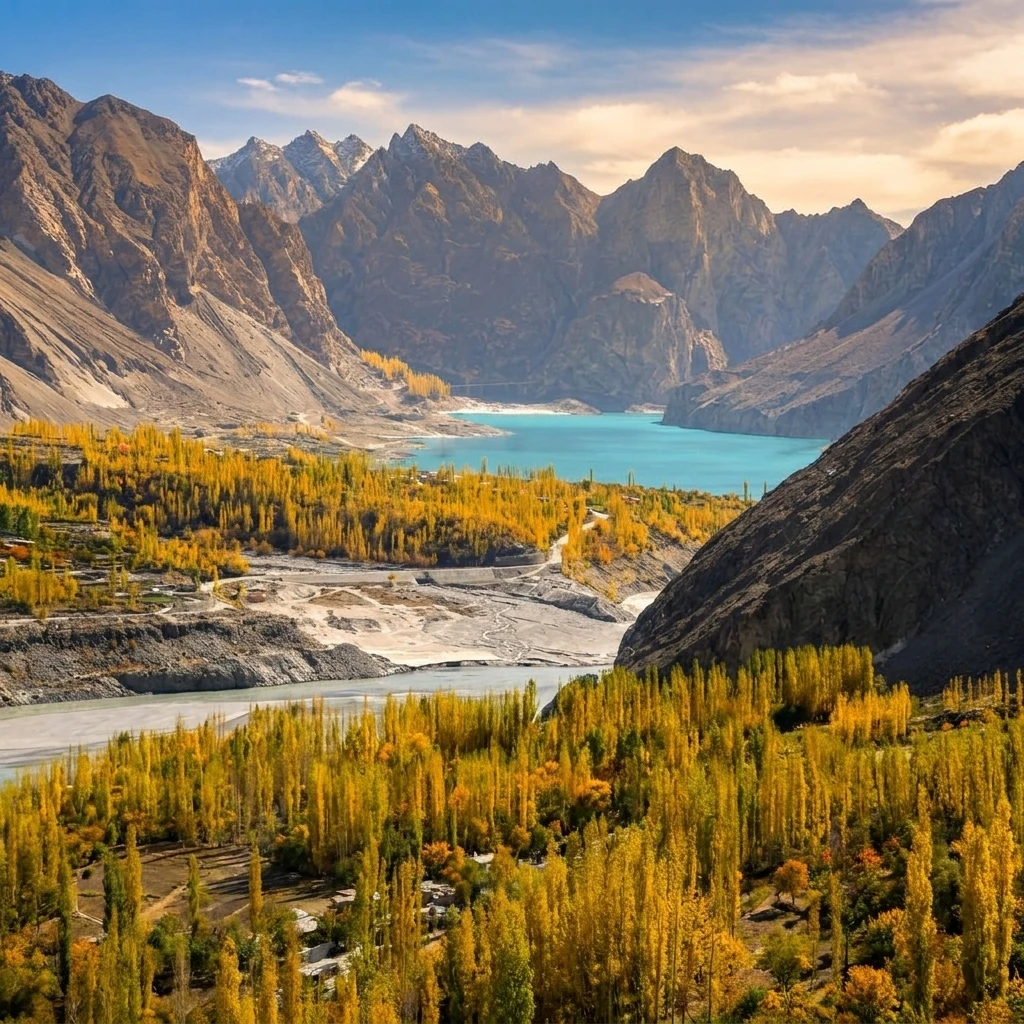
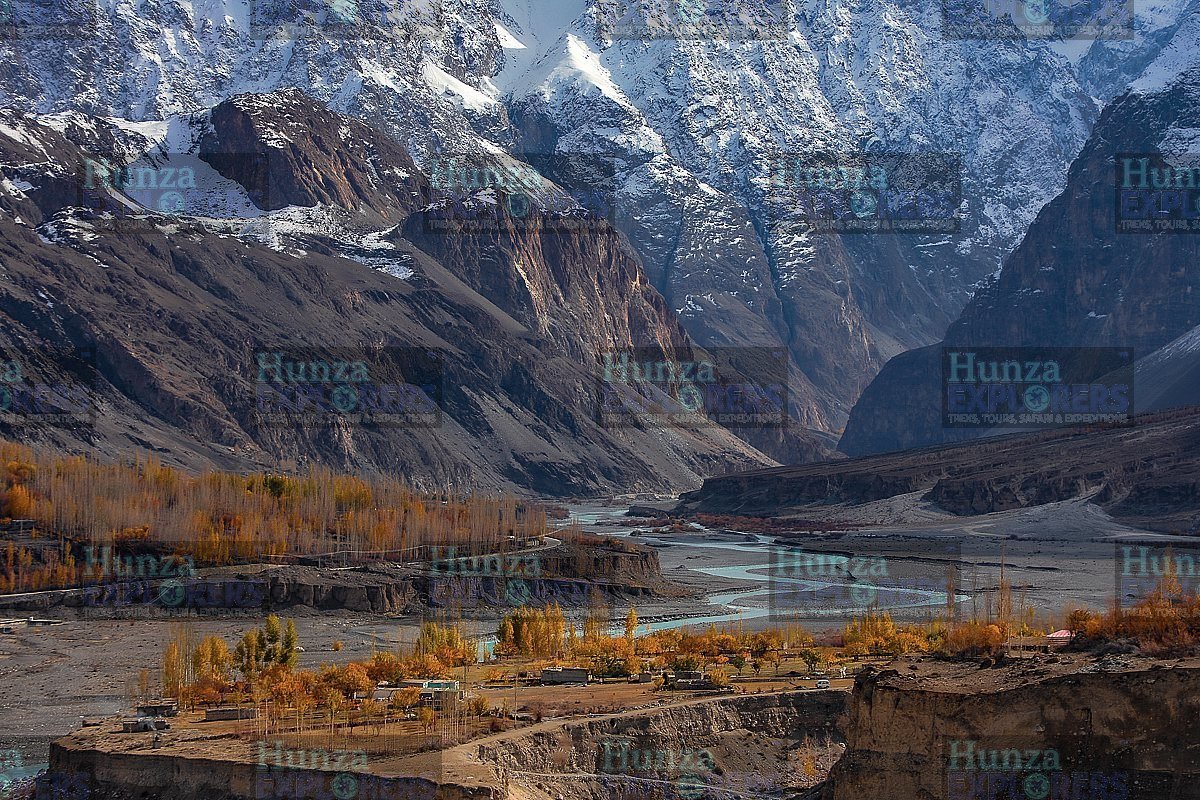
Golden autumn colours fill the villages and orchards of Hunza, framed by the rugged peaks of the Karakoram.
Autumn in Hunza: A Complete Guide to the Golden Season in Hunza Valley
There is a time of year when the mountains of Hunza look almost exactly as they do in photographs — but the experience of being there is very different from looking at a photograph.
The roads are quieter. The mornings are crisp. The orchards begin to change colour. Tall poplar trees turn yellow along the villages and the Karakoram Highway, while the high peaks remain rugged and imposing above them.
Then, as you travel north, the landscape changes again.
The golden trees around Shishkat appear beside the turquoise waters of Attabad Lake. In Gulmit, autumn settles around old village houses and fields beneath the high mountains of Gojal. The colours continue through Ghulkin, Hussaini and Passu, where the famous Passu Cones rise dramatically behind the autumn landscape. Further north, the villages of Khyber, Moorkhun and Sost offer another side of Upper Hunza, where the landscape becomes increasingly high, rugged and remote.
This is what makes autumn in Hunza so special.
It is not one viewpoint, one village or one famous photograph.
It is the journey through the valley.
For us at Hunza Explorers, autumn is one of the best times to travel through Hunza because the season allows travellers to experience both the natural landscape and the communities that live among it. The colour is spectacular, but there is much more happening beneath the autumn trees.
Families are finishing the year's agricultural work. Orchards are being harvested. Villages are preparing for winter. The light changes quickly across the mountains, and every section of the valley has its own character.
If you are planning a Hunza autumn tour, this guide explains what to expect, when to come, where to see the colours and how to make the most of your time in the valley.
When Does Autumn Begin in Hunza?
Autumn does not arrive in Hunza on a particular date.
The valley stretches across different elevations, and the change from summer green to autumn gold happens gradually. Weather, altitude and local conditions all influence when individual trees begin to change colour.
Generally, the first signs of autumn appear from late September, with October usually being the main period for experiencing the famous autumn colours of Hunza. Some areas can retain their colours into early November, while higher and colder locations may change earlier.
This gradual change is one of the best things about travelling through Hunza in autumn.
You are not looking at the same landscape every day.
The further you travel through the valley, the more the scenery changes.
September in Hunza
September is the beginning of the transition.
The valley can still have plenty of green, but the first yellow and golden leaves begin appearing among the orchards and poplar trees.
For travellers who prefer quieter conditions and a mixture of summer and autumn scenery, September can be an excellent time to visit.
October in Hunza
October is the month most travellers associate with autumn in Hunza.
This is when the landscape generally becomes most colourful, with golden poplars and changing orchards contrasting against the dry mountain slopes and high peaks.
For photography, October is particularly rewarding.
The combination of autumn foliage, clear mountain air and dramatic Karakoram scenery creates the landscapes that have made Hunza famous around the world.
November in Hunza
By November, the valley is beginning its transition towards winter.
Some areas can still have autumn colour, but many trees have already lost their leaves. Temperatures become considerably colder, particularly in Upper Hunza.
For travellers visiting later in the season, warm clothing becomes essential.
Why Is Autumn in Hunza So Beautiful?
The answer is not simply the trees.
It is the contrast.
Hunza is a high mountain valley surrounded by some of the world's most dramatic landscapes. The mountains themselves are often stark — enormous walls of rock, glaciers and snow-covered summits.
Then you look down into the villages.
There are orchards, fields, irrigation channels, old stone houses and rows of tall trees.
During autumn, these cultivated landscapes become golden.
The result is very different from an autumn forest.
In Hunza, the colours belong to the villages.
They grow around people's homes, fields and roads. They line the Karakoram Highway and surround historic settlements. They appear beside rivers and mountain streams.
This relationship between the mountains and the cultivated valley is what gives Hunza Valley in autumn its distinctive character.
Autumn colours spread through the villages and orchards of Hunza beneath the rugged peaks of the Karakoram.
Following the Autumn Colours from Hunza to Upper Hunza
One of the best ways to experience autumn is to travel gradually north through the valley.
Rather than thinking of Hunza as a collection of separate attractions, think of it as a journey.
The landscape around Central Hunza is different from the landscape around Shishkat. Shishkat is different from Gulmit. Gulmit is different from Passu. And by the time you reach Sost, you are in an entirely different high-mountain environment.
That progression is one of the great pleasures of an autumn road journey.
Shishkat: Where Autumn Meets Attabad Lake
For travellers coming from the south, Shishkat is an important part of the journey into Upper Hunza.
The village sits beside the dramatic landscape of Attabad Lake, with mountains rising sharply around the road and water.
In autumn, the trees around the settlement and nearby agricultural areas begin turning golden, creating a striking contrast with the blue and turquoise water of the lake.
This is one of those places where the autumn landscape is particularly impressive because of the combination of colours.
Golden trees.
Blue water.
Grey mountains.
And, above them, the higher peaks of the Karakoram.
The road through Shishkat is not simply a route to the next destination. It is one of the places where the transition from Central Hunza into Gojal becomes visually obvious.
Around Shishkat, the golden colours of autumn meet the turquoise waters and rugged mountains of Upper Hunza.
Gulmit: Autumn in the Heart of Gojal
Continue north and you reach Gulmit, one of the principal settlements of Gojal.
The landscape here feels more open and the mountains feel larger.
Gulmit is surrounded by fields, orchards and traditional homes, all set beneath the high peaks of Upper Hunza. During autumn, the trees around the village add warm colours to an otherwise rugged mountain landscape.
This is a place where it is worth getting out of the vehicle.
Walk through the village.
Look at the traditional houses.
Follow the small paths between fields.
Take photographs, but also pay attention to the details that do not appear in the typical landscape photograph.
The old irrigation channels.
The stone walls.
The agricultural terraces.
The wooden balconies.
The mountains rising above everything.
This is where autumn in Gojalbecomes more than a visual experience.
It becomes a cultural one.
Gulmit takes on a warm golden colour in autumn, with the traditional village landscape set beneath the high mountains of Gojal.
Ghulkin: A Village Beneath the High Peaks
A short journey from Gulmit brings you to Ghulkin.
Ghulkin is one of those places that rewards travellers who take the time to walk rather than simply stop for a photograph.
The village sits in an extraordinary mountain setting, and during autumn its trees create a colourful foreground beneath the rugged peaks.
The contrast is particularly striking from higher viewpoints, where you can see the village, agricultural land and surrounding mountains together.
For photographers, Ghulkin can be especially rewarding in the morning and late afternoon, when the changing light brings out the texture of the mountains and the warmth of the foliage.
But even without a camera, it is a beautiful place to experience the quieter side of Upper Hunza.
In Ghulkin, golden autumn trees surround a traditional mountain village beneath the dramatic peaks of Gojal.
Hussaini: Autumn Along the Karakoram Highway
Further north, the road continues towards Hussaini.
The landscape becomes increasingly dramatic as the Karakoram rises around the highway.
Hussaini is particularly well known for its suspension bridge, but the surrounding landscape deserves just as much attention.
In autumn, the road passes through changing vegetation and mountain settlements where the golden colours provide a striking contrast against the steep rock faces.
This is also one of the sections of the journey where you really appreciate the scale of the Karakoram Highway.
The road is not simply connecting villages.
It is crossing one of the world's great mountain landscapes.
The Karakoram Highway winds through the changing autumn landscape around Hussaini in Upper Hunza.
Passu: Golden Trees Beneath the Passu Cones
Then the landscape opens around Passu.
The first sight of the Passu Cones is one of the defining moments of travelling through Upper Hunza.
Their sharp, jagged peaks rise dramatically above the valley and dominate almost every view.
During autumn, the golden trees around Passu provide a remarkable foreground.
This is one of the classic scenes of autumn in Hunza: golden poplars and village landscapes below, the enormous Passu Cones behind them, and the clear mountain sky above.
But Passu is worth more than a quick photograph.
Spend some time here.
Walk around the village.
Look at the surrounding agricultural landscape.
Watch the mountains change colour as the sun moves across them.
The atmosphere is completely different in the early morning compared with the late afternoon.
The unmistakable Passu Cones rise dramatically above the golden autumn colours of Upper Hunza.
Khyber: A Quieter Side of Upper Hunza
Beyond Passu, the journey continues through the villages of Upper Hunza towards Khyber.
Khyber does not have the same international recognition as Passu, and that is precisely part of its appeal.
The landscape becomes quieter.
The villages are smaller.
The surrounding mountains feel even more dominant.
Autumn here is about the relationship between the small cultivated settlements and the enormous landscape around them.
For travellers who want to see more than the famous viewpoints, these lesser-known villages are an important part of the journey.
This is where having more time in the itinerary makes a real difference.
You can stop.
Walk.
Photograph.
Talk with your guide.
And see how autumn is experienced by the communities who live here.
In Khyber, the autumn landscape becomes quieter as small mountain communities sit beneath the high peaks of Upper Hunza.
Moorkhun: Autumn in the Wakhi Villages
The journey continues towards Moorkhun, another important settlement in Upper Hunza.
By this point, the landscape feels noticeably higher and more remote.
The villages of Gojal are closely connected with the agricultural cycle, and autumn is the time when much of the year's work is coming to an end.
The colours around Moorkhun are therefore not simply a seasonal attraction.
They are part of the landscape in which people live and work.
This is an excellent area for travellers who want to photograph village life rather than only dramatic mountain panoramas.
A row of trees beside a traditional home can sometimes tell you more about Upper Hunza than a famous viewpoint.
Autumn brings warm colours to the traditional villages of Moorkhun, surrounded by the rugged mountains of Upper Hunza.
Sost: The High-Mountain End of the Valley
Further north lies Sost, the last major settlement before the journey continues towards the Khunjerab Pass and the Pakistan–China border.
The landscape around Sost is noticeably different from the lower parts of Hunza.
The mountains become increasingly barren and imposing, while the vegetation becomes more limited.
Autumn here is therefore different as well.
You are no longer surrounded by the same density of orchards and trees found around Central Hunza or the lower parts of Gojal. Instead, the landscape becomes a stronger combination of small patches of vegetation and enormous high-mountain terrain.
This gradual change is one of the reasons we recommend travelling through the whole of Upper Hunza rather than choosing one location and staying there.
You see the valley evolve.
Near Sost, the autumn landscape gives way to the high, rugged environment of the upper Karakoram.
Central Hunza in Autumn: Karimabad, Altit and Duiker
While Upper Hunza deserves a major place in any autumn journey, Central Hunza should not be overlooked.
Karimabad, Altit and Duiker offer a different type of autumn landscape.
Here, the historic character of Hunza becomes more visible.
Karimabad
The old settlements around Karimabad are surrounded by orchards and terraces, and the autumn colours create a beautiful setting for exploring the historic heart of Hunza.
Baltit Fort stands above the valley, while the old streets and surrounding villages provide plenty of opportunities for walking and photography.
Altit
The historic settlement around Altit Fort offers another perspective on Hunza's past.
Autumn adds colour to the old village, gardens and agricultural areas, making this an excellent place to combine cultural sightseeing with seasonal photography.
Duiker
For a broader view, the high viewpoints around Duiker provide panoramic views across Hunza.
From above, you can see how the golden trees are distributed through the villages and agricultural terraces, with the surrounding mountains creating the enormous frame.
From the high slopes of Duiker, the autumn colours of Hunza spread across the valley beneath the surrounding Karakoram peaks.
What Makes Upper Hunza Special in Autumn?
If you are visiting Hunza specifically for autumn colours, do not make the mistake of thinking only about Karimabad.
Upper Hunza offers a completely different scale and character.
The sequence from Shishkat to Gulmit, Ghulkin, Hussaini, Passu, Khyber, Moorkhun and Sost takes you through one of the most spectacular sections of the Karakoram.
The villages become increasingly high and remote.
The mountains become more imposing.
The vegetation changes.
The autumn colours appear in different ways.
And the journey becomes increasingly connected with the traditional communities of Gojal.
This is particularly important for travellers who have several days available.
Instead of spending the entire trip around one town, follow the valley north.
That is where you begin to appreciate how diverse Hunza really is.
Autumn Photography in Hunza
For photographers, autumn in Hunza offers an unusually rich variety of subjects.
You can photograph:
Golden poplar-lined roads
Traditional villages
Historic forts
Agricultural terraces
Orchards
Attabad Lake
The Passu Cones
High mountain landscapes
Local village life
The Karakoram Highway
Autumn sunsets and mountain light
But some of the strongest images are not necessarily the obvious ones.
Look for the details.
An old wooden door surrounded by yellow leaves.
A farmer working in an orchard.
A village road disappearing beneath poplar trees.
A mountain reflected in a water channel.
A traditional house with the autumn landscape rising behind it.
These are the photographs that give a travel story a sense of place.
For landscape photography, early morning and late afternoon are generally the most rewarding periods. The low-angle light adds warmth to the trees and brings out the texture of the surrounding mountains.
And if photography is one of the main reasons for your journey, tell us when planning your tour.
A photography-focused itinerary should have more flexibility than a standard sightseeing programme.
What Is the Weather Like in Hunza During Autumn?
Autumn weather in Hunza changes considerably between September and November.
September can still be relatively mild during the daytime.
October generally brings cooler mornings and evenings, while sunny afternoons can remain comfortable for walking and sightseeing.
By late October and November, temperatures become noticeably colder, particularly in Upper Hunza.
The difference between daytime and nighttime temperatures is important.
A sunny afternoon around Gulmit or Passu can feel pleasant, but once the sun disappears behind the mountains, the temperature can drop quickly.
Travellers should therefore pack layers.
A warm jacket, fleece or sweater, comfortable walking shoes and warmer clothing for the evenings are essential.
If your itinerary continues towards Khunjerab and higher elevations, additional cold-weather clothing may be necessary.
What to Pack for an Autumn Trip to Hunza
For a normal autumn journey through Hunza, you do not need specialist expedition equipment.
You do need to be prepared for mountain weather.
We recommend bringing:
Warm jacket
Fleece or sweater
Comfortable walking shoes
Warm socks
Sunglasses
Sunscreen
Personal medication
Camera and spare batteries
Power bank
Small daypack
Gloves for colder periods
Thermal layers for late-season travel
Good footwear is particularly important because some of the best experiences happen away from the vehicle.
A short village walk can easily become an hour or two if you are enjoying the landscape.
How Many Days Do You Need for an Autumn Trip to Hunza?
If you only want to visit Karimabad and see the main attractions, a short stay is possible.
But if the purpose of your trip is to experience autumn in Hunza, we strongly recommend allowing more time.
A journey that includes Shishkat, Gulmit, Ghulkin, Hussaini, Passu, Khyber, Moorkhun and Sost should not be treated as a collection of quick stops.
Three or four nights can provide a good introduction to Hunza.
Five or more nights allow you to travel more slowly and spend meaningful time in both Central and Upper Hunza.
Photographers and travellers interested in village life may want even more flexibility.
And if you are travelling through Gilgit-Baltistan, Hunza can easily become part of a longer autumn journey that includes Nagar, Gilgit, Ghizer, Phandar, Skardu, Shigar or Khaplu, depending on the route and available time.
The Best Way to Experience Autumn in Hunza
The best autumn itinerary is not necessarily the one that covers the greatest number of attractions.
It is the one that gives you enough time to appreciate the journey.
Leave Karimabad in the morning.
Travel towards Shishkat.
Stop around Attabad Lake.
Continue into Gojal.
Spend time in Gulmit.
Walk in Ghulkin.
Photograph Hussaini.
Stay around Passu.
Continue towards Khyber, Moorkhun and Sost if your itinerary allows.
And do not be afraid to stop simply because something looks beautiful.
That is how autumn travel in Hunza works.
The valley is constantly giving you reasons to slow down.
Why Travel to Hunza with Hunza Explorers?
There are many ways to visit Hunza.
You can arrange a vehicle yourself, book accommodation independently and follow the main road.
For experienced travellers, that can work well.
But a well-designed journey through Hunza requires an understanding of the region beyond the major attractions.
At Hunza Explorers, our work is based in the region we know and operate in.
Since 2003, we have been organising tours, treks, expeditions and cultural journeys in Pakistan, with Hunza and Gilgit-Baltistan at the heart of our experience.
For autumn travel, local knowledge becomes particularly useful.
The colours are changing throughout the season.
The weather varies between Central and Upper Hunza.
Some villages deserve more time than a simple roadside stop.
And travellers with different interests need different itineraries.
A photographer should not necessarily travel on the same schedule as a family looking for a relaxed holiday.
A couple interested in culture may want more time in villages.
An experienced traveller may want to continue deeper into Gojal.
This is why our Hunza autumn tours can be arranged around the way you actually want to travel.
We can focus on the major attractions, spend more time in Upper Hunza, build an itinerary around photography or combine Hunza with a wider journey through northern Pakistan.
The important thing is that the itinerary should serve the traveller — not the other way around.
Frequently Asked Questions About Autumn in Hunza
When is autumn in Hunza?
Autumn generally begins from late September and continues through October into early November, although the exact timing varies according to altitude and weather.
What is the best month to visit Hunza for autumn colours?
October is generally the best month for travellers looking specifically for autumn foliage, but the colours do not appear everywhere at the same time.
Which part of Hunza has the best autumn colours?
Autumn colours can be found throughout Hunza. Upper Hunza and Gojal — including Shishkat, Gulmit, Ghulkin, Hussaini, Passu, Khyber and Moorkhun — offer particularly impressive combinations of colourful villages and dramatic mountain scenery.
Is Karimabad good for autumn?
Yes. Karimabad, Altit and Duiker offer beautiful autumn landscapes combined with historic forts, old settlements and panoramic views. However, travellers should not limit their autumn journey to Central Hunza.
Is Upper Hunza accessible in autumn?
Yes. Upper Hunza remains one of the highlights of the autumn season. Travellers should, however, be prepared for increasingly colder conditions as they travel towards higher elevations and later in the season.
Is October cold in Hunza?
October can be pleasant during sunny daytime hours but mornings and evenings are cold. Upper Hunza is colder, particularly around later October.
Is autumn good for photography?
Autumn is one of the best seasons for photography in Hunza because of the combination of golden foliage, traditional villages, historic architecture, lakes and high Karakoram peaks.
How long should I stay in Hunza?
We recommend at least three to four nights for a relaxed introduction. If you want to explore Upper Hunza properly, photograph the autumn landscapes or travel beyond Passu towards Sost, allowing more time is preferable.
Can I combine Hunza with Skardu?
Yes. Hunza can be combined with Skardu and other destinations in Gilgit-Baltistan as part of a longer autumn itinerary.
Autumn in Hunza Is a Journey, Not Just a Season
The first photograph you see of autumn in Hunza might show Karimabad.
Another might show Attabad Lake.
Another will probably show the Passu Cones framed by golden trees.
All of them are Hunza.
But none of them tells the complete story.
The real experience is travelling through the valley and watching the landscape change.
From the orchards of Central Hunza to Shishkat beside Attabad Lake.
From Gulmit and Ghulkin beneath the high peaks of Gojal.
Through Hussaini and towards Passu.
Beyond Passu to Khyber and Moorkhun.
And finally towards Sost, where the cultivated valleys give way to the increasingly stark high-mountain landscape on the road to Khunjerab.
That is autumn in Hunza.
It is not one golden viewpoint.
It is a valley changing gradually around you.
The trees change colour. The air becomes colder. The villages prepare for winter. The mountains seem even more imposing against the clear autumn sky.
And somewhere along that road, usually when you are not looking for it, you will find the scene that stays with you.
Come for the autumn colours. Travel through the valley. And give Hunza enough time to show you everything else.
Local guides and trip planners writing from the Karakoram.
Hunza Explorers
AI Travel Assistant
Start Chat
Please enter your real contact details before chatting.
Welcome to Hunza Explorers. I am your professional travel advisor. I can assist with tours, destinations, pricing, travel seasons, and custom trip planning.
I can help you with:
Tour recommendations and details
Pricing and availability
Best travel seasons and weather
Visa and packing tips
Custom trip planning
What would you like to know?
Request Custom Tour
Fill out the form below and we'll get back to you with a customized itinerary.